AI · August 18, 2026
Best AI orchestration platform for product teams
What changed in 2025–2026 and how to pick the best AI workflow orchestration platform for product teams, with concrete trade-offs and governance calls.

What is the best AI workflow orchestration platform for product teams?
The best platform is the one that satisfies your governance needs, delivery deadline, and extensibility priorities first. As of mid-2026, managed agent platforms speed governed launches, workflow iPaaS composes LLM steps in familiar tools, open-source frameworks maximize control, and event-driven services fit bespoke scaling. Choose by the risks you must reduce earliest.
Key takeaways
- • Governance now decides the shortlist. As of July 2026, major agent platforms emphasize build, scale, and govern in production, which reduces audit and ops drag earlier in the lifecycle.
- • Sequential agent loops are a first-class pattern. As of February 2026, documented chains of subtasks let teams split flows for latency and maintainability instead of monolithic prompts.
- • TEFCA-related provisions finalized in December 2024 raised the bar on auditable routing and provenance for health data flows that touch orchestration.
- • NIST's December 2025 draft on AI-era cybersecurity signals reviewers will probe identity, data minimization, and trace controls in AI-integrated workflows.
What changed for orchestration since 2024?
Two dimensions matured by mid-2026: platform governance and documented multi-agent patterns. Together they shift selection from "what can we wire up" to "what will pass review and scale."
As of July 31, 2026, Google Cloud documents Vertex AI Agent Builder as a suite that helps developers build, scale, and govern AI agents in production. Two years ago, many teams hand-assembled chains with limited governance surfaces. Now, governance is called out in product scope, which changes how product teams evaluate suitability for regulated or review-heavy contexts. Source: Google Cloud Vertex AI Agent Builder documentation, 2026-07-31.
On February 19, 2026, Microsoft published guidance on calling agent loops sequentially in Azure Logic Apps to improve performance, management, and scalability. That codifies sequential chains of subtasks as an out-of-the-box pattern rather than a custom trick, which affects how teams model latency, retries, and error isolation. Source: Microsoft Learn, "Call Agent Loops Sequentially," 2026-02-19.
In the HTI-2 Final Rule issued on December 16, 2024, ONC finalized TEFCA-related provisions creating 45 CFR Part 172. For product teams that route health data or integrate with exchange participants, orchestration now needs clear audit trails and policy enforcement points. Source: HTI-2 Final Rule, 2024-12-16 (89 FR 101772).
In December 2025, NIST released a preliminary draft that rethinks cybersecurity for the AI era for a 45-day comment period. That signals increasing attention to identity, data minimization, and traceability in AI-enabled systems. Source: NIST news, 2025-12.
How should product teams define "best" for AI orchestration?
Define "best" by the highest-risk constraint you must respect in the next two quarters. If governance review is the blocker, prefer platforms with built-in policy and audit surfaces. If delivery speed dominates, favor what composes cleanly with your stack today and can be refactored later.
Write down four constraints in plain terms: delivery date, governance and audit needs, extensibility requirements, and operating budget. Map each candidate to those constraints. In every demo, ask to see three flows live: a sequential chain of agent subtasks, end-to-end run history search, and a policy boundary that inspects inputs and outputs. If any of those need custom glue to show, that is schedule risk.
What are the main orchestration options and trade-offs?
Four approaches cover most product use cases: managed agent platforms, workflow iPaaS with LLM steps, open-source orchestrators, and event-driven services. Each optimizes a different constraint.
- • Managed agent platforms: Strong for governed launches and centralized tooling. You get defined agent primitives, policy hooks, and scaling paths. Extensibility is bounded by the platform's plugin and API model.
- • Workflow iPaaS + LLM steps: Best when your organization already automates with a workflow service. You add LLM or agent steps into existing triggers and approvals. Governance aligns to what your IT already knows, but agent-specific depth can lag.
- • Open-source orchestrators: Strongest control and portability. You design the exact agent loop, state store, and tool sandbox. You carry more burden for guardrails, run history, and upgrades.
- • Event-driven services: A fit for high-scale bespoke apps. You treat orchestration as functions, queues, and events. Powerful for latency and cost shaping, but governance and traceability are do-it-yourself unless paired with supporting services.
Comparison table: approaches vs selection axes
| Approach | Governance and audit readiness | Delivery speed in existing stack | Extensibility and control | Vendor lock-in exposure |
|---|---|---|---|---|
| Managed agent platforms | High out of the box | Fast for greenfield | Medium (plugin model) | Medium to high |
| Workflow iPaaS + LLM steps | Medium to high (familiar IT) | Fast if iPaaS is standard | Medium | Medium |
| Open-source orchestrators | Variable, you build it | Moderate | High | Low |
| Event-driven services | Variable, you assemble controls | Moderate | High | Medium |
What is the buyer actually evaluating?
You are evaluating whether the platform lets you ship a valuable flow on time while passing review without expensive rework. That reduces to governance surfaces, composition speed, and future change cost.
Use this checklist during evaluation:
- • Governance exposure
- • Can you define and enforce policies on inputs, tools, and outputs without custom code?
- • Is run history searchable by entity, step, and outcome for audits?
- • Composition and patterns
- • Are sequential agent loops and retries first-class, with documented patterns?
- • Can you isolate tools per step to minimize over-permissioning?
- • Extensibility and portability
- • Are custom tools, models, and data connectors supported without forking?
- • Is there a clean path to swap models or move workloads if requirements change?
- • Observability and iteration
- • Can product and data teams annotate runs and compare variants?
- • Are failure modes explicit, with dead-letter or human-in-the-loop paths?
- • Integration fit
- • Does it slot into your triggers, secrets, CI/CD, and incident process today?
How the new guidance changes platform selection
The 2026 guidance pushes platforms with clear guardrails and documented agent-loop patterns to the front of the line. That shortens the path to greenlight because reviewers can anchor to recognizable controls.
- • Governance is explicit. As of July 2026, Google Cloud describes Vertex AI Agent Builder as focused on building, scaling, and governing AI agents in production. That framing helps buyers evidence policy enforcement and lifecycle controls during reviews. Source: Google Cloud documentation, 2026-07-31.
- • Patterns are codified. As of February 2026, Microsoft shows how to call agent loops sequentially in Logic Apps to improve performance, management, and scalability. Buyers can now ask vendors to demonstrate that precise pattern rather than accept generic claims. Source: Microsoft Learn, 2026-02-19.
- • Health data routing has a new reference point. In December 2024, HTI-2 finalized TEFCA-related provisions in 45 CFR Part 172, which directs attention to auditable exchange behaviors. This affects orchestration choices that broker or transform health data. Source: ONC, 2024-12-16.
- • Security expectations are shifting. In December 2025, NIST released a preliminary draft that rethinks cybersecurity for the AI era. Reviewers may seek identity scoping, data minimization, and traceability within AI-infused workflows. Source: NIST, 2025-12.
Where teams get tripped up, and how to avoid it
Most delays come from missing guardrails and ambiguous run history. Reviews stall when a platform cannot show who did what, with which inputs, and under which policy.
Avoid common pitfalls:
- • Treat prompt chains as code. Version them, stage them, and gate rollouts with policy.
- • Instrument run history early. Ensure you can query by customer, step, and failure reason before you scale traffic.
- • Split long prompts into agent subtasks. Use sequential loops with explicit tool boundaries to reduce blast radius and improve debuggability.
- • Minimize data exposure by default. Route only the fields a step needs, and verify the platform can enforce that without custom wrappers.
- • Prepare for model or tool swap. Select APIs and abstractions that keep you from hard-binding flows to a single vendor capability.
Example sequencing: from prototype to governed flow
A practical path is to start with a minimal agent loop, then add policy and history before expanding tools. The order matters because it prevents rework when reviews begin.
- • Prototype a single-loop agent that delivers one user-visible value.
- • Add structured logging and run history search.
- • Introduce policy enforcement on inputs and tools.
- • Expand to sequential loops for subtasks, each with scoped tools.
- • Integrate incident and rollback hooks, then raise traffic.
Statistics and facts to anchor decisions
- • Google Cloud states that Vertex AI Agent Builder helps developers build, scale, and govern AI agents in production. Date: 2026-07-31. Source: Google Cloud Vertex AI Agent Builder documentation.
- • Microsoft documents that calling agent loops sequentially in Azure Logic Apps can improve performance, management, and scalability. Date: 2026-02-19. Source: Microsoft Learn.
- • ONC's HTI-2 Final Rule finalized TEFCA-related provisions creating 45 CFR Part 172. Date: 2024-12-16 (89 FR 101772). Source: ONC/Federal Register.
- • NIST released a preliminary draft of AI-era cybersecurity guidance for a 45-day public comment period. Date: 2025-12. Source: NIST.
Our take
We think many teams overweight raw flexibility and underweight governance surfaces in their first platform choice. The result is speed in month one and gridlock in month four when audits start. As of 2026, there is no shortage of ways to chain prompts. What changed is that major vendors now document sequential agent loops and position governance as a first-class capability. We would start with the platform that proves policy enforcement and run history in a live demo, even if it constrains some early design choices. If health data is in scope, the HTI-2 Final Rule's TEFCA-related provisions make auditable routing a near-term requirement, not a future add-on. The approach we would not take is a custom event-driven build without a plan for identity, data minimization, and trace controls inspired by the NIST draft. That tends to slip schedules when reviewers escalate questions you cannot answer from logs.
FAQ
What is AI workflow orchestration for product teams?
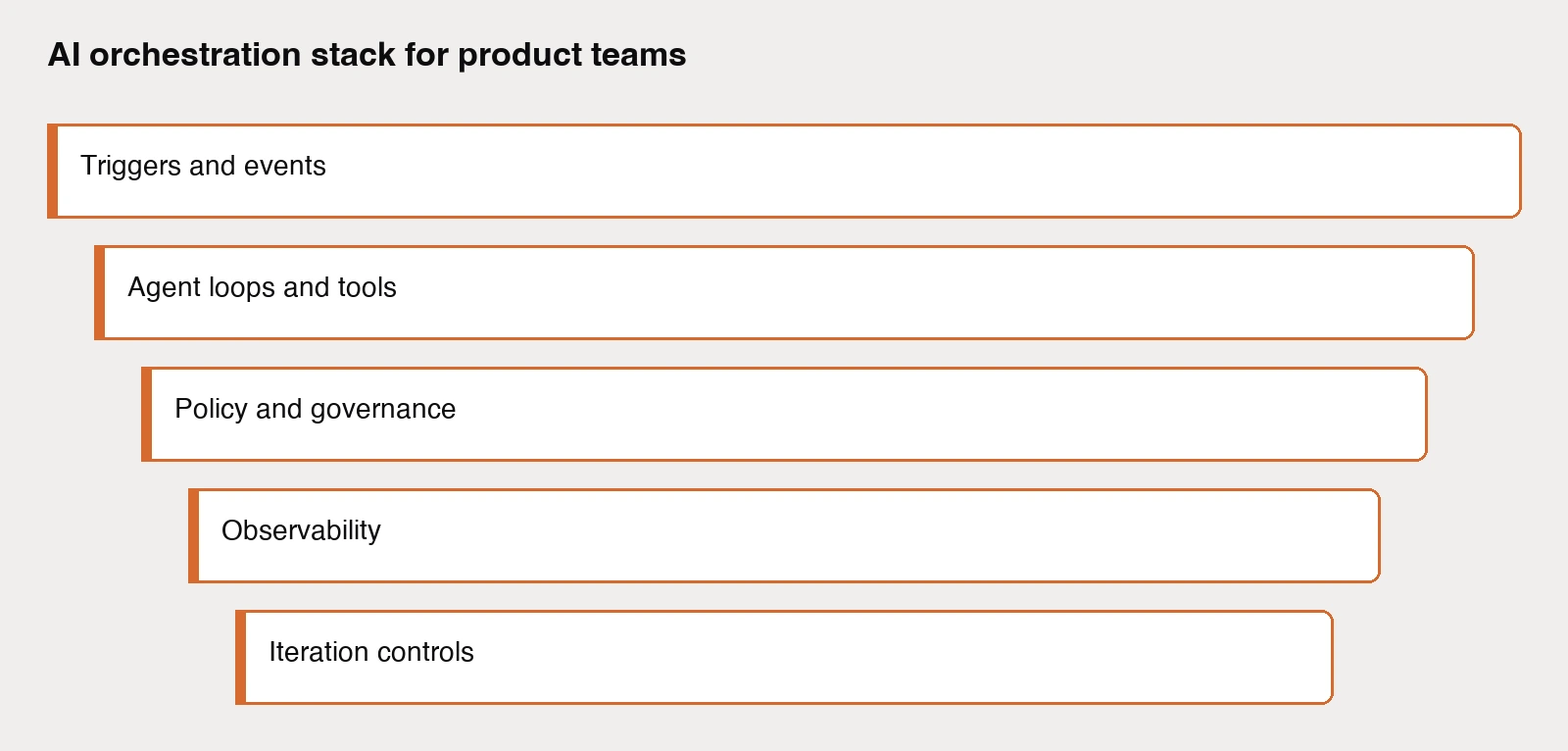
It is how you coordinate LLM or agent steps, tools, data access, and policies to deliver a product outcome. For product teams, orchestration includes how you trigger flows, split work across sequential agent loops, enforce input and output rules, observe runs, and iterate safely. The right platform lets you ship value on time while satisfying governance and audit expectations.
How do sequential agent loops help in production?
They break a complex task into smaller subtasks with explicit boundaries, which improves debuggability and reduces risk. As of February 19, 2026, Microsoft documents this pattern in Azure Logic Apps to improve performance, management, and scalability. By isolating steps, you can set tighter tool permissions, add retries where needed, and tune latency more predictably.
How does the HTI-2 Final Rule affect orchestration choices?
In December 2024, HTI-2 finalized TEFCA-related provisions in 45 CFR Part 172. If your product routes or transforms health data, you will need auditable policies and clear provenance. Choose platforms that expose policy enforcement points and run history searchable by entity and step. That reduces rework when stakeholders ask for evidence.
Do we need a managed agent platform, or can we use our iPaaS?
If your organization already uses a workflow service and you need to ship quickly, adding LLM steps to that iPaaS can be effective. If you need deeper agent patterns or stronger built-in governance, a managed agent platform may fit better. The trade-off is extensibility and vendor constraints versus speed in your existing stack.
What should we see in a good demo?
Ask to see a sequential chain of subtasks, searchable run history across steps, and a policy boundary that filters inputs or tools in real time. If any of these require custom code or an external system to demonstrate, note the schedule and compliance risk that implies.
What to do next
Define your top four constraints, shortlist one option in each approach category, and run head-to-head demos using the checklist above. Lock the pick that ships value and passes review with the least rework.